
AI Directors: Breathing Story through a Game World
One of the strongest promises of systemic game design is that a game can surprise even its creators. Not because it is random, but because its systems can read a situation, interpret pressure, and respond with something that feels authored in the moment. That is the design space of the AI Director.
One of the strongest promises of systemic game design is that a game can surprise even its creators. Not because it is random, but because its systems can read a situation, interpret pressure, and respond with something that feels authored in the moment.
That is the design space of the AI Director.
An AI Director is not simply “enemy AI.” It is a higher-level system that observes the state of play and decides how the world should react. Instead of asking, “What should this monster do next?”, it asks broader questions: Is the player bored? Is the player overwhelmed? Has the current route become too predictable? Is the world applying enough pressure? Should the game breathe for a moment, or should it strike?
This makes AI Directors especially powerful for emergent gameplay. They do not replace hand-authored design. They orchestrate it.
The Science Behind the Director
The theoretical foundation behind most AI Director systems sits close to two well-known ideas in game research: Flow Theory and Dynamic Difficulty Adjustment.
Flow Theory, popularized by Mihaly Csikszentmihalyi, describes a state of deep engagement that emerges when challenge and skill are well matched. If challenge is too low, the player becomes bored. If challenge is too high, the player becomes anxious or frustrated. Good games often work by keeping players inside this shifting channel between boredom and frustration.
Dynamic Difficulty Adjustment, or DDA, applies that principle computationally. Instead of asking the player to choose “Easy,” “Normal,” or “Hard” at the start, the game continuously adjusts parts of the experience based on observed player behavior. Robin Hunicke’s Hamlet system, for example, explored DDA as a probabilistic tool for adapting challenge in real time. Later surveys and experiments in the field have continued to frame DDA as a way to keep players engaged by tuning challenge to performance rather than relying only on static difficulty modes.
Crit42 Studio’s own background intersects directly with this research. In the 2021 undergraduate thesis “Comparação de ajustes dinâmicos de dificuldade aplicados a diferentes elementos de jogo,” Eduardo de Azevedo dos Santos, now the founder of Crit42, compared four DDA conditions in a 2D platformer: no DDA, DDA applied to platforms, DDA applied to jump parameters, and DDA applied to both. The study used remote tests with 155 participants and concluded that the combined DDA condition was the most effective at supporting flow, followed by platform-based DDA.
That conclusion is important for AI Directors because it suggests that adaptivity is not only about increasing or decreasing numbers. Where the system intervenes matters. Adjusting enemies, resources, map structures, movement affordances, encounter pacing, or narrative events can produce very different player experiences.
From Difficulty Adjustment to Dramatic Pacing
The most famous commercial example of an AI Director is Valve’s Left 4 Dead. Valve described the system as a way to algorithmically adjust dramatic pacing during play. The Director does not merely spawn zombies. It manages intensity. It creates peaks, releases tension, and tries to avoid long stretches of flat repetition.
This is a crucial distinction. Traditional DDA often thinks in terms of difficulty: is the player winning too easily or losing too often? An AI Director thinks in terms of experience: what emotional rhythm should happen next?
That difference matters because “harder” is not always better. Sometimes the right choice is to remove pressure, add a merchant, delay a boss, redirect wandering enemies, or give the player a strange event that changes the texture of the run. The goal is not to punish the player. The goal is to keep the world alive.
For emergent games, this is especially valuable. Procedural generation can create variety, but variety alone does not guarantee drama. A procedural map can still feel empty. A random spawn table can still feel mechanical. An AI Director gives procedural systems a sense of timing, intention, and responsiveness.
Case Study: A Tale of Silent Depths
In A Tale of Silent Depths, the player commands an Ark: a massive mobile submarine base and one of humanity’s last refuges in a post-apocalyptic underwater world. The game combines procedural exploration, tactical turn-based combat, resource pressure, factions, merchants, hostile creatures, and a world designed to feel unstable and alive.
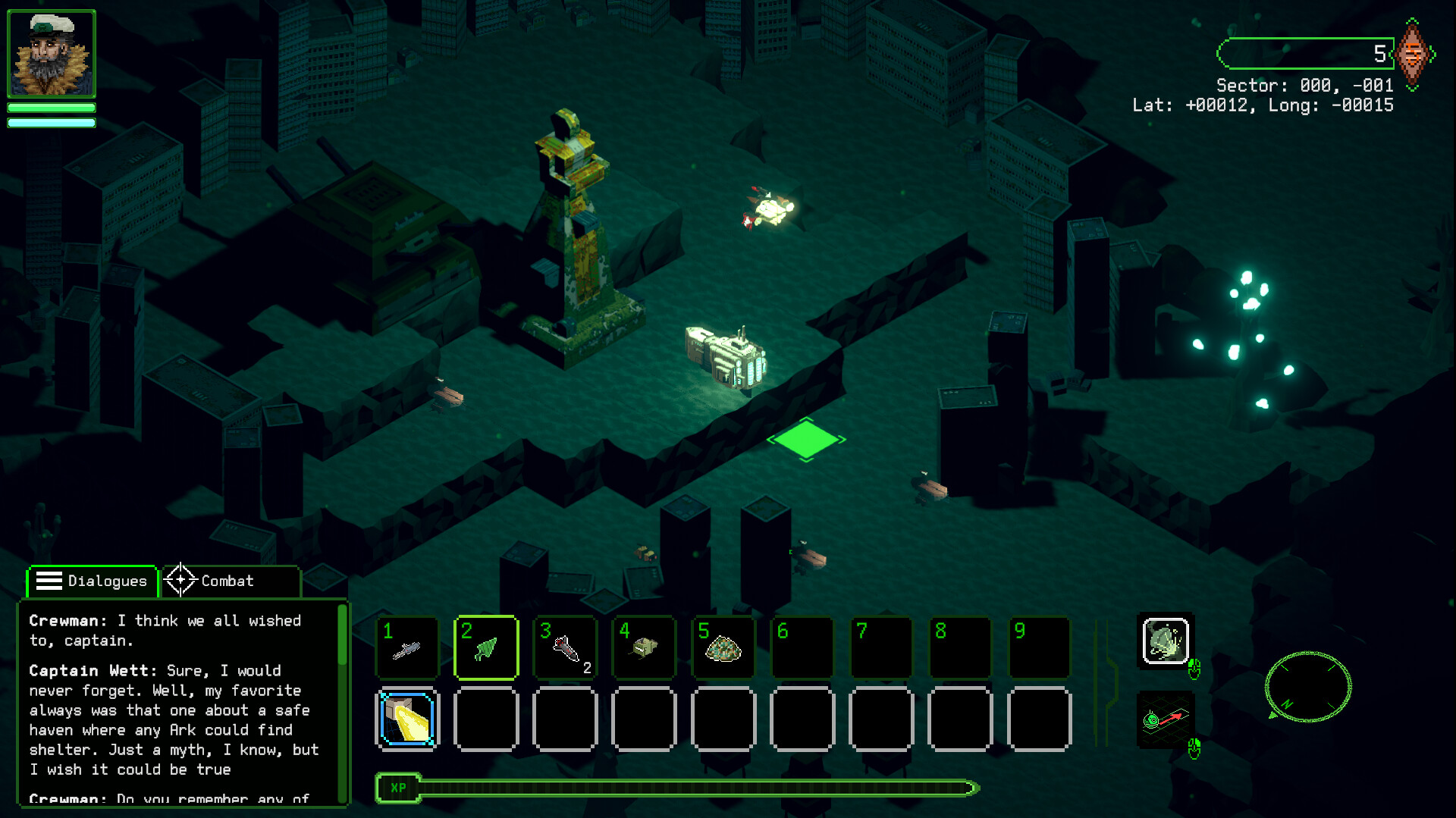
For this game, Crit42 explored an AI Director built from a novel combination: a local, offline LLM working alongside traditional heuristic systems. The heuristic layer calculates pressure and pacing through the lens of boredom versus frustration, drawing from the same flow-based design logic behind DDA research. The local LLM layer helps produce or select more contextual situations without depending on external servers.
The Director in A Tale of Silent Depths can:
- Spawn unique situations during exploration.
- Introduce powerful bosses.
- Direct idle enemies in the world to move toward the player.
- Control spawn ratios.
- Select what to spawn from traditional spawn tables, including biome enemies, hostile encounters, and merchants.
This hybrid approach matters. Heuristics are reliable, measurable, and predictable enough for balance. A local LLM adds expressive flexibility: it can help vary situations, contextualize events, and reduce the feeling that the world is merely rolling dice behind the curtain. Used together, they point toward a practical model for independent studios: not “AI replaces design,” but “AI helps authored systems recombine in more responsive ways.”
What Worked
The strongest part of the system is that it treats the ocean not as a backdrop, but as an active pressure engine.
A Tale of Silent Depths is a game about survival under pressure. The player is not simply moving from node to node. They are navigating scarcity, danger, unknown routes, hostile factions, and the emotional weight of a world that should feel like it is watching. An AI Director supports that fantasy because it can make the environment respond when the player becomes too comfortable.
The second strength is the combination of traditional spawn tables with higher-level direction. Spawn tables are useful because they preserve design control: designers can define which enemies belong to a biome, which merchants are appropriate, and which bosses should be rare. The Director then acts as a curator, selecting from those authored possibilities based on current pressure.
The third strength is offline execution: for a single-player game, a local AI system avoids several problems common to cloud-based AI: latency, cost, dependency on external services, and long-term preservation risk. It also keeps the system closer to the traditional craft of game development, where the shipped game remains self-contained. We believe this as something important for players, as offline play has been a core of PC gaming for decades.
What Could Be Better
The next step is measurement.
A Director becomes more powerful when it has a clearer model of the player. In future iterations, the system could better track signals such as damage taken, recent deaths, combat duration, resource depletion, distance traveled without meaningful events, repeated routes, merchant usage, retreat behavior, and time since the last high-intensity moment. Even though the system already analyze some data from the ones cited before, we could improve the algorithm and variables being taken into account, as those signals could feed a “tension score” or “flow estimate” that updates during play.
The second improvement would be stronger separation between difficulty, novelty, and narrative pressure. These are related but not identical. A boss increases difficulty. A strange ruin increases novelty. A merchant can lower frustration while still deepening narrative texture. A faction patrol might increase danger but also make the world feel politically alive. Treating these as separate axes would give the Director more expressive control.
A third improvement would be after-action analysis. After a run, the system could evaluate which interventions worked. Did the player survive after the Director reduced pressure? Did a boss create excitement or cause a quit? Did merchants appear too late to matter? This could support future balancing without making the Director opaque or uncontrollable.
Finally, the Director could benefit from authored “dramatic grammars.” Instead of spawning isolated events, it could assemble small arcs: warning → pressure → confrontation → consequence → recovery. That structure would allow emergent play to feel less like disconnected incidents and more like stories produced by systems.
The Design Risk: Invisible Manipulation
AI Directors need restraint.
If players feel the game is cheating, the system fails. If they notice that enemies always appear exactly when they are weak, the world stops feeling alive and starts feeling manipulative. The best Directors are often invisible. They create the sensation that the world is coherent, not that an algorithm is adjusting the thermostat.
This is why authored constraints matter. The Director should not be allowed to do anything at any time. It needs rules: biome logic, cooldowns, fairness thresholds, narrative boundaries, resource limits, and safe failure states. In other words, an AI Director is not a replacement for balance. It is a balance tool that must itself be balanced.
Why This Matters for Emergent Gameplay
Emergent gameplay depends on meaningful interaction between systems. But emergence also needs rhythm. Without rhythm, systemic games can become either chaotic or dull.
AI Directors are interesting because they sit between authored design and procedural possibility. They allow designers to create ingredients, rules, and boundaries, while giving the game a way to decide when those ingredients should appear. They make a world feel less like a script and more like an organism.
For Crit42 Studio, A Tale of Silent Depths was an experiment in that direction: a tactical RPG where the ocean is not static, where enemies can be redirected, where bosses and merchants are part of a living pressure curve, and where a local AI layer can help the game produce situations that feel less predictable.
AI in games should not be only about generating more content. It should be about creating better relationships between player, system, and world.
A good AI Director does not ask, “What can I generate?”
It asks, “What does this moment need?”
If this vision resonates with you, whether as a player, designer, or researcher, we invite you to be part of the conversation. At Crit42 Studio, we are actively exploring how systems like AI Directors can shape the future of emergent gameplay, and we believe that the best ideas grow through collaboration and shared curiosity.
Join our Discord server to discuss design, share feedback, follow the development of our games, and connect with others who are passionate about building living, breathing game worlds!
- gamedev
- gamedesign